5,441,512 DATED AUGUST 15, 1995
HIGH
INCISION VELOCITY VIBRATING SCALPEL STRUCTURE & METHOD
VIBRO™
|
|
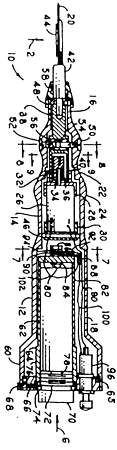
The invention relates to surgical scalpels, and refers more specifically to a high incision velocity vibrating scalpel structure and method of power driving a scalpel blade, which structure may be completely self contained so as to be useful in remote areas without local power sources and by which structure and method a conventional linear scalpel blade is vibrated at a high velocity to produce incisions in tissue which heal rapidly with little or no scar formation.
In the past, surgical scalpels have generally been elongated handles with straight scalpel blades secured to one end thereof, which has been drawn across tissue to be incised manually.
The present invention is a high incision velocity vibrating scalpel structure and method. In use, the high incision velocity vibrating scalpel of the invention produces incisions in tissue across which the straight scalpel blade attached to the scalpel of the invention is drawn, which incisions heal rapidly with a minimum of scar formation.
The high incision velocity scalpel structure of the invention includes an elongated cylindrical handle, the exterior surface of one end of which is shaped to receive the fingers and thumb of a surgeon utilizing the scalpel. Motor means is resiliently mounted in one end of the body member and includes a motor, an eccentric, unbalanced, fly weight driven by the motor and a scalpel blade support member rigidly secured to the motor, which motor means is supported on pivot structure by the handle. Conventional means for selectively energizing the motor means is provided in the other end of the body member.
In the method of use of the high incision velocity vibrating scalpel, the motor is energized to rotate the eccentric, unbalanced, fly wheel, whereby the entire motor means including the scalpel blade support member is caused to vibrate at a high velocity on the pivot structure to produce an essentially accurate movement of the linear scalpel blade secured to the blade support member. The scalpel blade thus moves in high velocity vibrations, mostly perpendicularly to the axis of rotation of the eccentric, unbalanced, fly wheel, and to a lesser extent longitudinally of the scalpel structure. Such high velocity vibrating movement of the linear scalpel blade produces the desired incision when the scalpel blade is drawn across tissue to be incised.