4,850,886 DATED JULY 25, 1989
POWER
CORD DECOUPLER AND METHOD
PULL-ME™
|
|
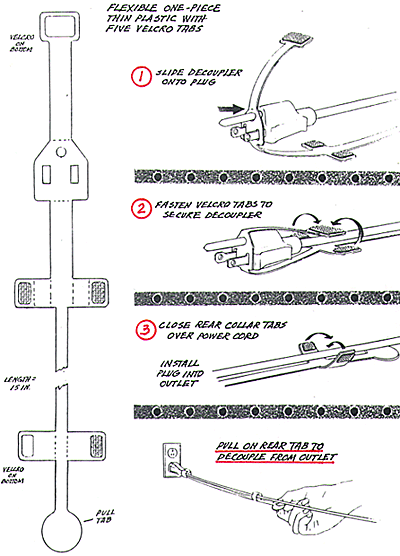
This invention relates to electrical power cords and more particularly to a decoupler and method for decoupling a plug of a power cord from an electrical outlet, by way of example, in a home or office. When decoupling a plug from an electrical outlet, it is a common practice to grasp and exert a pulling force on the wire attached to the plug with the entire fist rather than the plug. This is due to the natural reluctance of many persons to be near electrical outlets, the low and variable locations of wall outlets and the sometimes inaccessibility of wall and ceiling outlets.
When an excessive pulling force is indiscriminately exerted by the entire fist on the wire, the lateral component of the pulling force may damage the wire, plug and outlet and/or cause electrical shock.
Manufacturers have addressed this problem by strengthening the attachments of wires to plugs of power cords. However, this has provided only partial relief and further improvements would be provided with a decoupler which was particularly adapted for grasping the wire with a user's fingers, at a distance from the plug. Such a device would recognize the practice of many users, i.e. of grasping the wire rather than the plug, and consequently reduce their exposure to electrical shock and/or reduce damage to power cords, plugs and outlets.
The present invention is directed to the task of decoupling a power cord plug from an electrical outlet and more particularly to a convenient, effective, easy to use, decoupler and method for grasping and applying a pulling force to a power cord with a user's fingers at a distance from the plug. In addition to its convenience, the invention will find favor with persons who are reluctant to grasp power cord plugs, reduce their exposure to electrical shock and/or reduce damage to cords, plugs and outlets. These benefits are derived by exerting decoupling forces to wires of power cords with fingers rather than entire fists at distances from power cord plugs.
The decoupler comprises a collar or flange attached to the wire at a distance from the plug. The collar or flange may be formed integrally with the cord at a fixed distance from the plug or be selectively adjustable to apply decoupling forces with fingers rather than entire fists at distances from power cord plugs.
The method for decoupling the plug from the outlet comprises the steps of selectively positioning a collar or flange on the wire portion of a power cord at a distance from the plug, grasping the collar or flange with the user's fingers and applying a pulling force with the user's fingers to the collar or flange to decouple the plug from the outlet.
One feature of the invention is that it can be readily applied to existing power cords without modifications to the power cords.
It is a primary object of the present invention to provide an economical means and method for decoupling a power cord from an electrical outlet which is safe, convenient, effective, and easy to use.
It is another object, in addition to the foregoing object, to provide means for decoupling a power cord from an electrical outlet which is adapted to the current practice of grasping the wire portion of a power cord.
It is a further object, in addition to the foregoing objects, to provide a decoupler which is adaptable to a variety of power cord gauges and styles.
Further objects, advantages and benefits will be apparent from the ensuing description and accompanying drawings which disclose the invention in detail. The best mode contemplated in practicing the invention is disclosed and the subject matter in which exclusive rights are claimed is set forth in each of the numbered claims at the conclusion of the detailed description.