4,887,599 DATED DECEMBER 19, 1989
POWERED
ROTARY SCALPEL STRUCTURE
|
|
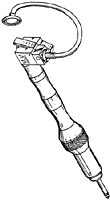
The purpose of the invention is to add velocity to a surgical incision to produce a more cosmetic scar and to avoid keloid formation especially in those individuals who are genetically prone. The power driven rotary scalpel includes a hollow cylindrical handle, a housing at one end of the handle for receiving an electric motor and electrical power for the rotary scalpel, a blade support arm at the other end of the handle on which a circular scalpel blade is mounted for rotation and means for driving the rotary scalpel blade through the support arm and handle from the motor including a gear box.
In accordance with the invention, the blade support arm is releasably secured to the handle by support arm securing structure including rotating pin structure, which pin structure may be bowed to reduce tolerance requirements. Alternatively, the pin of the rotating pin structure may include an eccentric portion. Also with one modification of the support arm securing structure the support arm may be secured to the handle of the rotary scalpel in different angular positions with respect thereto.
The power driven rotary scalpel also includes a light for illuminating the area of the blade which light is always on when power is applied to the power driven rotary scalpel and indicates a power on condition.
Also, a wire protector is provided in accordance with the invention to protect electrical leads as they pass into and out of the handle within which the motor is housed.
Remote switch structure and a modification thereof is further provided for turning on the electric motor at the rear of the handle from the front of the handle.
The structure of the invention further includes a rotary scalpel blade having concave sides for reducing friction between the blade and tissue being cut thereby. Modified blade structures in accordance with the invention include a depressed side, circular blade structure and a flat side, circular blade structure with an annular recess at the outer periphery thereof. Part circular and radial linear, rotating scalpel blades are also contemplated in accordance with the invention.
A hollow flat disc protector for rotary circular scalpel blades including a living hinge and an axially split resilient cylinder closure therefore is also provided in accordance with the invention, along with modified blade protectors including a flat slotted envelope type rotary circular blade protector and a sticky paper blade protector.
The rotary scalpel structure of the invention further includes a support stand for sterilization of the support arm and circular blade secured thereto in the form of a bent wire or narrow strip and a sled like control for limiting the depth of cut possible with the rotary scalpel structure of the invention.
The method of the invention includes rotating a circular scalpel blade and drawing it across tissue in which an incision is desired. In the method of the invention, the rotary scalpel blade is rotated at a speed such that the circumferential speed of the rotary scalpel blade is between 4 and 7 centimeters per second. Also, in accordance with the method of the invention, the depth of cut with the rotating scalpel is limited and the scalpel blades are protected during sterilization or during shipment.
|
zoom in |

Also, a wire protector is provided in accordance with the invention to protect electrical leads as they pass into and out of the handle within which the motor is housed.
Remote switch structure and a modification thereof is further provided for turning on the electric motor at the rear of the handle from the front of the handle.
The structure of the invention further includes a rotary scalpel blade having concave sides for reducing friction between the blade and tissue being cut thereby. Modified blade structures in accordance with the invention include a depressed side, circular blade structure and a flat side, circular blade structure with an annular recess at the outer periphery tehreof. Part circular and radial linear, rotating scalpel blades are also contemplated in accordance with the invention.
A hollow flat disc protector for rotary circular scalpel blades including a living hinge and an axially split resilient cylinder closure therefore is also provided in accordance with the invention, along with modified blade protectors including a flat slotted envelope type rotary circular blade protector and a sticky paper blade protector.
The rotary scalpel structure of the invention further includes a support stand for sterilization of the support arm and circular blade secured thereto in the form of a bent wire or narrow strip and a sled like control for limiting the depth of cut possible with the rotary scalpel structure of the invention.
The method of the invention includes rotating a circular scalpel blade and drawing it across tissue in which an incision is desired. In the method of the invention, the rotary scalpel blade is rotated at a speed such that the circumferential speed of the rotary scalpel blade is between 4 and 7 centimeters per second. Also, in accordance with the method of the invention, the depth of cut with the rotating scalpel is limited and the scalpel blades are protected during sterilization or during shipment.