5,061,269 DATED OCTOBER 29, 1991
SURGICAL
RONGEUR POWER GRIP STRUCTURE AND METHOD
POWERGRIP™
|
|
The purpose of this invention is to facilitate the surgeon in fashioning or removing bone in surgery. Incremental power is achieved with feedback so that the surgeon can without reducing tactile control be less fatigued when repeated gripping is required.
In the past, surgeon's rongeurs of both the Kerrison and Leksell types have generally been manually actuated structures wherein squeezing of relatively pivoted handles constructed much like plier handles has produced a punching or scissor-like cutting action due to relative movement of two parallel elongated members secured to the handles and having gripping or crushing means at one end thereof. Such structure is tiring when gripped repeatedly to open a human skull for example. Further such structure unnecessarily increases the time to perform such procedure and thus prolongs operating time which is undesirable for both patient and surgeon.
A few power operated rongeurs have been suggested in the past. They have, however, been hydraulically or pneumatically actuated and thus have required access to gas or hydraulic fluid under pressure by means of heavy and cumbersome pressure lines and thus are undesirable. Further, such power assisted surgeon's rongeurs as have been available in the past have been particularly complicated and lacked feedback in the handle to provide the operator with a direct appreciation of the resistance to cutting and therefore the need for more or less assist power, and also were expensive to manufacture and inefficient in use.
The rongeur structure and method of the invention is electrically actuated through thin and light wires to provide a power assisted grip which may be actuated in multiple stages, without the encumbrances and weight drag of heavy and large hydraulic or pneumatic connecting lines.
The rongeur structure of the invention comprises two side by side elongated members having gripping, cutting or crushing means at one end thereof operable on relative axial
movement between the elongated members to grip, cut or crush desired material. A first handle part is integrally constructed with the other end of one of the elongated members, a second handle part is pivotally secured to the first handle part adjacent to the other end of the first elongated member and engages the other end of the other elongated member in a lost motion connection.
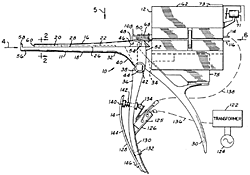
In one preferred embodiment of the invention, a pair of electrically actuated power cylinders are secured between the one handle part and the other end of the other elongated member whereby on energizing the electrically actuated power cylinders relative longitudinal movement is produced between the elongated members.
In another embodiment of the invention, three electrically actuated power cylinders are secured between the one handle part and the other end of the other elongated member and means are provided for manually closing a switch to energize the electrically actuated power cylinders in multiple stages, using the cylinders independently or in groups.
A plurality of gripping, cutting and crushing means such as wrench, spreader, prier, lifter and suction cup means as well as various rongeur-type tips such as Kerrison and Leksell rongeur tips may be utilized with the power grip structures of the inventions.
Further, the invention is not limited to rongeurs but may also be useful in constructing electrical power actuated adjustable self-tightening wrenches, spreaders, priers, lifters, shears, pliers, snips, nibblers, suction grippers and the like, useful in industries such as in robotics, for example.
In accordance with the method of the invention, power cylinder structure is electrically actuated to assist in rongeur or other tool operation. The method of the invention includes multiple stage actuation of electrically actuated power cylinders in groups where a plurality of power cylinders are provided.